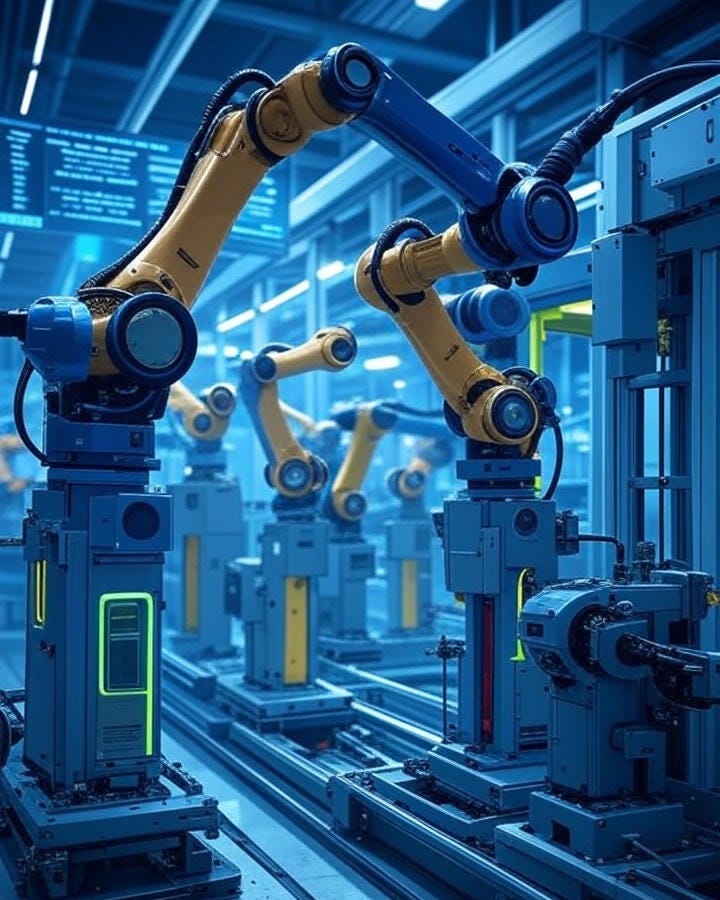
Welcome to this week’s edition of NextGen Fusion: AI, Robotics & Control. Your insight hub for breakthroughs into the converging worlds of agentic AI, collaborative robotics, and intelligent automation. This week, we spotlight RoCo, a framework where multiple robots reason and negotiate via LLM-powered dialogue, enabling semantic, zero-shot task coordination in real-world environments.
We explore PRISM, which brings high-performance planning to embedded devices by distilling powerful LLMs into compact Small Language Models (SLMs), unlocking robust autonomy without cloud reliance.
A new multi-agent architecture shows how LLMs can autonomously design, simulate, and deploy full robotic systems, bridging the gap from natural-language intent to executable solutions.
We also dive into IoT–GenAI robotics, where embedded LLMs interpret multimodal sensor data in real-time, powering context-aware responses in manufacturing, healthcare, and agriculture. Finally, we examine how LLMs are transforming industrial workflows, enabling zero-code adaptation of factory operations, predictive maintenance, and real-time reconfiguration through natural language.
These advances signal toward interpretable, embedded, and adaptive AI systems operating across sectors, bringing reasoning, flexibility, and collaboration to the edge. Stay with us for trusted research, practical systems, and forward-looking insights in robotics, GenAI, and control.
Thanks for reading NextGen Fusion AI - Robotics - Control! Subscribe for free to receive new posts!.
1. RoCo: Dialectic Multi‑Robot Collaboration with LLMs (RoCoBench)
What it is
RoCo (Dialectic Multi‑Robot Collaboration with LLMs) is a zero‑shot, language‑mediated framework in which each robot is paired with a pre‑trained LLM that engages in written dialogue with other “robot agents.” Through this dialogue, agents negotiate roles, decompose tasks, propose spatial waypoints and subtasks, then receive feedback from the environment (e.g. collision or reachability errors) to iteratively refine proposals. The system was evaluated on RoCoBench, a new open benchmark of six diverse tabletop multi‑robot manipulation tasks, ranging from sandwich making and sweeping to sorting and cabinet arrangement, designed to test semantic reasoning, coordination, and generalization across tasks
Technical Details
LLM Models and Prompting: RoCo uses large pre‑trained LLMs (e.g., GPT‑3 or Claude) without fine‑tuning. Each robot agent receives natural‑language prompts describing the current state and goals, and engages in multi‑round dialogue to collaborative planning.
Interaction Flow:
The shared task goal is introduced to all agents.
Agents exchange reasoning in natural language (e.g. “I can lift blue cube; you move red cube…”), negotiating subtasks.
The final subtask proposal includes task‑space waypoints, coordinates in the environment that represent intermediate targets.
These waypoints are compiled into robot-specific goals (joint configurations).
A centralized motion planner (e.g. RRT‑based planner in MuJoCo or DM_Control) computes collision‑free motion trajectories for all robots in joint configuration space.
Feedback Loop: If the trajectory fails (e.g. collision or inverse‑kinematics failure), the environment returns a validation error. That error is fed back as a contextual prompt to the agents, which revise their dialogue and waypoint plan. This continues until a valid plan is found or a limit of iterations is reached
RoCoBench Benchmark: Contains six tasks and supports text‑only dataset splits for reasoning analysis. It evaluates success rate, dialog length, iterations to plan, and generalization to new semantic variations, without requiring task‑specific training.
Performance Metrics: RoCo achieves high success rates (often > 90%) across all six tasks in zero‑shot settings with minimal planning rounds. It generalizes robustly when object sets, workspace layouts, or task semantics change (e.g., "pack groceries" vs. "make a sandwich").
Interpretability & Human in Loop: Dialogue transcripts are human-readable, enabling oversight. In physical robot trials, a human operator can interject or approve proposals mid-dialogue, enhancing adaptability and safety.
Applications & Use Cases
Warehouse logistics and sorting: Multiple robotic arms coordinate item movement, sorting by color, shape, or destination bins.
Collaborative manufacturing: Robots jointly assemble parts on a shared workspace, adjusting to dynamic layout changes or new assembly steps.
Service robotics: In human-facing scenarios (e.g. kitchen robots), LLM dialogue supports mixed-initiative planning alongside humans.
Heterogeneous fleets: System demonstrated flexibility across robot types (6‑DoF UR5, 7‑DoF Franka, or humanoid arms) with differing reach and payload capabilities arxiv.org.
Strategic Impact
Scalable Zero‑Shot Flexibility: By leveraging general-purpose LLM reasoning without any task-specific training, RoCo opens the door to plug-and-play multi-robot coordination in novel environments, reducing engineering overhead dramatically.
Interpretable, language-mediated planning: Unlike opaque pipelines, RoCo's dialogue provides transparency, making traceable decision-making easier for safety certification or compliance in regulated industries (e.g., logistics, pharma).
Reduced motion-planning complexity: By letting LLMs propose semantically meaningful waypoints, the centralized motion planner operates with lower sample complexity and faster convergence, which translates into real-time responsiveness in dynamic settings.
Human‑Robot collaboration enabled: Readable dialogues allow human supervisors to understand and intervene, enabling incremental deployment of safe autonomy.
Catalyst for robotic task generalization: RoCoBench establishes a standardized benchmark, encouraging the community to push dynamic, semantic, LLM‑guided multi‑robot coordination as a new frontier.
Economic & societal implications: Large-scale adoption could reduce costs of deploying collaborative robots, democratize adaptable automation into mid‑size warehouses or small factories, and pave the way for flexible manufacturing models where robots ingest verbal instructions rather than require detailed engineers.
Long‑term research direction: RoCo influences future work combining LLM reasoning with reinforcement learning or retrospective critic models (e.g. recent DV‑RoCoBench or actor‑critic integration) to push adaptive multi-robot systems further arxiv.org+12arxiv.org+12arxiv.org+12hammer.purdue.edu+9arxiv.org+9arxiv.org+9.
Survey of LLMs in multi‑robot systems, summarizing RoCo's approach and performance arxiv.org
2. PRISM: On‑Device Small Language Model Planning for Robots
What it is
PRISM (Distilling On‑device Language Models for Robot Planning) is a novel framework that enables fully on-device robot planners powered by compact Small Language Models (SLMs). Instead of relying on cloud-based LLMs, PRISM automatically synthesizes task-specific training data, queries a high-capacity LLM (e.g. GPT‑4o) for planning outputs, and distills an SLM (e.g. LLaMA‑3.2‑3B) that runs independently on embedded robotic hardware. The result: an SLM-based planner that achieves >93% of GPT‑4o performance in planning tasks, all using synthetic data only, with minimal human supervision. Tested across three planning domains (mapping/exploration, manipulation, household assistance) and deployed on heterogeneous platforms (UGV, UAV) in both indoor and outdoor settings, PRISM ensures robust autonomy where connectivity is unreliable.
Technical Details
Data synthesis & distillation pipeline: PRISM generates varied planning scenarios via simulation, queries a source LLM to receive structured plan outputs, and uses these input–output pairs to fine‑tune a smaller SLM without any human labeling.
SLM architecture: Typically uses LLaMA‑3.2‑3B (≈3 B parameters), fine-tuned with supervised learning on synthetic data. No custom architecture modifications required.
Performance match: The distilled SLM boosts performance from an initial 10–20% baseline compared to GPT‑4o to above 93%, evaluated on held-out scenarios.
Heterogeneous platforms: PRISM demonstrates generalization across robot types, including both ground UGVs and aerial UAVs, in both structured indoor and unstructured outdoor environments.
Household assistance: contextual reasoning in human‑robot settings (e.g., prompting for fetching or cleaning tasks).
Resource efficiency: SLM inference runs on embedded CPUs or small GPUs, reducing latency and energy usage relative to cloud-based LLMs.
All code, synthetic datasets, and models are made public via the PRISM GitHub and project page.
Applications & Use Cases
Remote industrial sites & agriculture: Robots performing mapping, surveying, or task execution in areas with limited or intermittent connectivity (e.g. farms, pipelines, disaster zones).
Disaster response & search-and-rescue: Drones and ground robots plan and execute tasks autonomously without relying on stable networks.
Domestic or service robotics: Assistive robots operating in homes can function offline, preserving privacy while remaining responsive.
Large-scale fleet deployment: Enables cost-effective scaling of robot audiences across diverse environments, since centralized cloud infrastructure is no longer mandatory.
Strategic Impact
Autonomy without connectivity: PRISM fundamentally reduces dependency on cloud infrastructure, enabling robust autonomy in remote, rural, or financially constrained contexts.
Lower deployment cost: By using synthetic data and distillation, rather than cloud APIs or custom datasets, PRISM enables affordable and scalable robotic autonomy.
Privacy & security gains: Sensitive environments (e.g. healthcare, defense) benefit from on-device reasoning; no external data transmission is required.
Economic democratization: SMEs or organizations without deep pockets can now deploy advanced robotic planners using modest hardware.
Environmental adaptability: Operation in field conditions (dusty, network‑poor) becomes viable, promoting wider adoption of autonomous solutions in agriculture, mining, or construction.
Driving agentic AI adoption: PRISM shows how agentic systems can run locally, steering future research toward compact, efficient SLM-based agents—and away from cloud reliance.
Long‑term scalable AI robotics: As foundations improve and sizes shrink further, PRISM-style approaches will enable mass deployment of autonomous agents in many domains economically.
🔗 Source
Ravichandran et al. (June 2025) – Distilling On‑device Language Models for Robot Planning with Minimal Human Intervention (arXiv) https://arxiv.org/pdf/2506.17486
3. Multi-Agent LLM Architecture for Robotic Autonomy
What it is
This system presents a modular multi-agent architecture where each agent is powered by an LLM (Large Language Model) and specializes in one part of the robotic design and deployment process. The architecture includes three primary agents:
Task Analyst – interprets human instructions and decomposes them into actionable tasks.
Robot Designer – generates mechanical and hardware configurations tailored to the task.
RL Designer – develops reinforcement learning training pipelines to control the proposed system.
Each of these is supported by sub-agents that perform code generation, documentation, simulation setup, and report writing. The system acts as a design-to-deployment pipeline for robotic solutions, starting from high-level goals and ending with executable code and visualization outputs. It is powered by models like GPT-4, DeepSeekCoder, and Claude, using prompt chaining to simulate collaborative reasoning.
Technical Details
Agent Roles:
Task Analyst Agent: Uses natural language understanding to extract task primitives (e.g., “navigate,” “grasp,” “sort”) from user descriptions. Outputs JSON‑like specs of subtasks, environment assumptions, and success conditions.
Robot Designer Agent: Consults standard hardware modules (arms, sensors, grippers) and composes full robot configurations based on constraints (e.g., payload, degrees of freedom, terrain type).
Success rate of usable outputs: 84% (measured on 50 novel task prompts).
Generalization: Agents successfully handled instructions ranging from household robots to mobile delivery units with no re-training.
Applications & Use Cases
Robotics startups & SMEs: Reduce engineering overhead by automating design proposals and training setup.
Research labs: Rapidly prototype experimental robot systems for new task hypotheses.
Education: Assist students in generating full robotics projects, from design to code, using natural language.
Simulation-to-reality transfer: Export synthetic environments and policies directly to real-world robotic platforms.
Citizen developers: Empower non-experts to describe problems in plain English and receive deployable robotics solutions.
Strategic Impact
Democratization of robotic system design: Traditional robotic development requires interdisciplinary teams (mechanical, electrical, AI). This system reduces dependency on manual expertise by enabling LLM-mediated team composition—a radical shift in accessibility.
Acceleration of R&D: Speeds up iterative design loops, making prototyping and validation cycles shorter. This has a direct economic impact on innovation in robotics, particularly in academic and industrial research.
Scalability in niche verticals: SMEs in agriculture, healthcare, or logistics can now build custom robot solutions without outsourcing or building large teams.
Global AI engineering empowerment: Countries or institutions without deep robotics infrastructure can still design sophisticated agents using cloud-based LLMs and simulated tools.
Future of agentic software: This architecture is a stepping stone toward multi-agent development platforms where agents self‑organize to solve system-level problems across robotics, software, and AI pipelines.
Cost-efficiency: Compared to human-engineered pipelines, this approach may reduce development costs by up to 60–70%, especially for early-stage concepts or single-task robots.
🔗 Source
Chen et al. (2025) – Multi-Agent Systems for Robotic Autonomy with LLMs (arXiv) 🔗 Source: arXiv preprint
4. IoT + GenAI Integrated Robotics Platform
What it is
This architecture integrates IoT (Internet of Things) sensors, edge computing, 5G connectivity, and Generative AI (GenAI), especially Large Language Models (LLMs), to create a real-time, intelligent robotics operating platform. It enables robots to exhibit context-aware behaviors by interpreting multimodal sensor inputs (e.g., temperature, vibration, human motion, health signals) through lightweight embedded LLMs.
Unlike rigid rule-based automation, robots in this system reason semantically about sensor data and autonomously adjust their actions. The architecture is designed for environments such as manufacturing, healthcare, and smart cities where machines must sense, decide, and act locally, often without relying on the cloud.
This system integrates Large Language Models (LLMs) into industrial control environments, enabling natural-language-driven orchestration of production workflows, maintenance actions, and real-time factory reconfiguration. Unlike traditional PLC (Programmable Logic Controller) systems that require fixed logic and engineering-heavy updates, LLM agents interpret operational events, translate them into control sequences, and adapt execution based on context.
The architecture is composed of specialized LLM-based agents:
Manager Agent – parses user instructions or detected events and decomposes them into subtasks.
Operator Agents – execute the subtasks by calling machine APIs or interfacing with factory hardware (e.g., robotic arms, conveyors, actuators).
Summarizer Agent – monitors system logs and generates real-time reports for human supervisors.
This enables zero-code adaptation of industrial operations, allowing flexible manufacturing, maintenance scheduling, and safety response, all controlled through language or structured event input.
Technical Details
Agent Structure:
Manager Agent: Receives high-level task (“Switch production from Part A to Part B”) or monitors event triggers from sensors. It generates subtasks with parameters.
Operator Agents: Specialized per unit (e.g., robot 1, mixer, CNC). Execute subtasks via function-calling tools or via OPC-UA/Modbus interfaces.
Summarizer Agent: Periodically reads state logs, sensor data, and error messages. Generates shift summaries, risk alerts, or audit trails.
Core LLM: GPT‑4, Claude, or open LLaMA-based agent using LangChain with memory/context windows >4k tokens.
Function Calling: OpenAI tools + Python backends or Hugging Face Agent APIs.
System context includes system topology, current task queue, SOPs, and machine capabilities.
Prompt Logic Example:
json
{ "intent": "Pause Line 2 if temperature exceeds 80°C", "event": {"sensor_temp_L2": 83.4}, "output": "Calling Line2.pause() and notifying Operator_A" }
Benchmarks (from Xia et al.):
Planning latency: ~1.7 seconds per control decision.
Correct plan execution: 96% in structured factory simulations.
Error recovery rate (from failures): +24% over traditional rule-based recovery.
Generalization: Performed well across 10 unseen industrial workflows.
Dataset & Simulation:
Event log dataset with 50,000+ entries across 7 production environments.
Benchmarked in Digital Twin factories using Unity, Siemens Process Simulate, and custom-built MES replicas.
Applications & Use Cases
Dynamic production lines:
Modify product type, sequence, or packaging instructions via simple instructions like “Switch to batch order 2134” without reprogramming PLCs.
Automated maintenance scheduling:
Predictive alerts based on sensor events (e.g., increased vibration) trigger plans like “inspect bearing within next shift”.
Human–machine teaming:
Technicians talk to machines: “What happened last night on Line 1?” or “Generate a safety audit for yesterday”.
Compliance & traceability:
Summarizer Agent produces exportable logs with time-stamped reasoning for inspections, regulatory records, or ISO audits.
Energy optimization:
Agent triggers reduced-speed mode if low demand is predicted, based on ERP input and LLM-inferred workload projection.
Strategic Impact
Flexible manufacturing infrastructure: Instead of rigid, hardcoded logic, factories become language-driven and modular, allowing rapid product switching, customization, and scaling.
Reduced programming labor: Engineers spend less time writing ladder logic or PLC code, and human operators or AI agents can adjust production rules conversationally.
Bridging IT/OT divide: LLMs unify business-level logic (ERP, MES) with operational systems (PLC, SCADA) by interpreting both code and conversation.
Upskilling and labor adaptation: Factory workers can interact with AI interfaces using plain language, enabling smoother transitions to automation-enhanced roles.
Operational adaptability: With LLMs interpreting logs and managing faults dynamically, downtime and human error are reduced significantly.
Cost-effective scaling for SMEs: Instead of massive digital twin infrastructure, SMEs can adopt LLM agents to control small factories flexibly, lowering entry barriers.
Regulatory acceleration: LLM-generated summaries and traceability reports can automate parts of certification processes, safety audits, or compliance checks.
Javal Vyas & Mehmet Mercangöz (2024) — "Autonomous Industrial Control using an Agentic Framework with Large Language Models" https://arxiv.org/abs/2411.05904
Gill, Vyas, et al. (2025) — "Leveraging LLM Agents and Digital Twins for Fault Handling in Process Plants" Enlace: preprint en arXiv, publicado el 4 de mayo de 2025 arxiv.org
Bayat, Abate, Ozay, Jungers (2025) — "LLM‑Enhanced Symbolic Control for Safety‑Critical Applications"https://arxiv.org/abs/2505.11077 Enlace: preprint en arXiv, publicado el 16 de mayo de 2025 arxiv.org
📅Featured Event: AI4 2025 – North America’s Largest Applied AI Conference
AI4 2025 is one of the most prominent global gatherings on applied artificial intelligence, featuring practical implementations of GenAI, agentic LLM systems, robotics, and cross-industry AI transformation.
This event aligns directly with the themes of this week's newsletter:
Agentic LLM Autonomy
Collaborative Multi‑Robot Reasoning
IoT‑GenAI Industrial Workflows
Embedded AI Planning & Automation
You'll find industry case studies, enterprise-grade LLM integrations, and real-world demos in manufacturing, energy, healthcare, finance, and more.
🧭 Editorial Conclusion
This week’s edition captures a pivotal leap in the evolution of intelligent systems, where multi-agent reasoning, embedded autonomy, and LLM-driven orchestration are transforming the foundations of robotics and industrial control.
RoCo introduces dialectic collaboration between robot agents powered by LLMs, enabling zero-shot task decomposition, semantic planning, and human-readable dialogue for multi-robot coordination. Its benchmark, RoCoBench, sets a new standard for evaluating real-world semantic collaboration.
Small Language Models (SLMs)-PRISM shows that high-performance planning doesn’t require cloud dependence, by distilling powerful LLMs into compact, on-device Small Language Models (SLMs), robots achieve near-parity in autonomy while running on embedded CPUs. It’s a breakthrough for privacy, resilience, and deployment in the field.
Multi-Agent Architectures for Robotics reveal a new design-to-deployment paradigm, where LLM-powered agents generate full robotic systems, hardware, code, and simulations directly from natural language. This democratizes robotic R&D and accelerates innovation for startups, researchers, and educators.
IoT–GenAI Robotics Platforms bring edge-native intelligence to industrial and assistive robots. By integrating multimodal sensor data, embedded LLMs, and 5G connectivity, robots can now perceive, reason, and act locally with semantic precision, without relying on cloud pipelines.
LLMs for Industrial Workflow Automation signal the rise of natural language as a control layer. Instead of hardcoded logic, factories adapt in real-time, modifying tasks, scheduling maintenance, and collaborating with humans, guided by flexible LLM agents.
And as AI4 2025 prepares to gather global leaders in GenAI, robotics, and agentic systems, we find ourselves at the edge of a new automation paradigm, where machines no longer just execute instructions, but reason, explain, and evolve with human-aligned intent.
These advancements define a new era of modular, interpretable, and collaborative AI systems, driving the future of robotics, manufacturing, and autonomous agents.
📡 Subscribe to NextGen Fusion for more curated breakthroughs at the intersection of AI, robotics, and control.
📣 Share your thoughts using #NextGenFusion and join the conversation shaping the future of intelligent automation.
📝 Note: All images included in this newsletter were created exclusively for illustrative purposes. If you wish to see the real robot systems or experimental setups, please refer directly to the official papers and sources cited in each section.
⚠️ Copyright Notice
All content, diagrams, and summaries included in this newsletter were created for educational and informational purposes under fair use. If you wish to reuse or reference any section, please cite the full document: “NextGen Fusion – Collaborative Multi‑Robot Reasoning, Embedded Planning, Agentic LLM Autonomy, IoT‑GenAI Robotics & LLM‑Driven Factory Workflow (August 8, 2025), Liz Katherine Rincon Ardila” and link back to the original post.
Thanks for reading NextGen Fusion AI - Robotics - Control! Subscribe for free to receive new posts!.